





KOCHI:
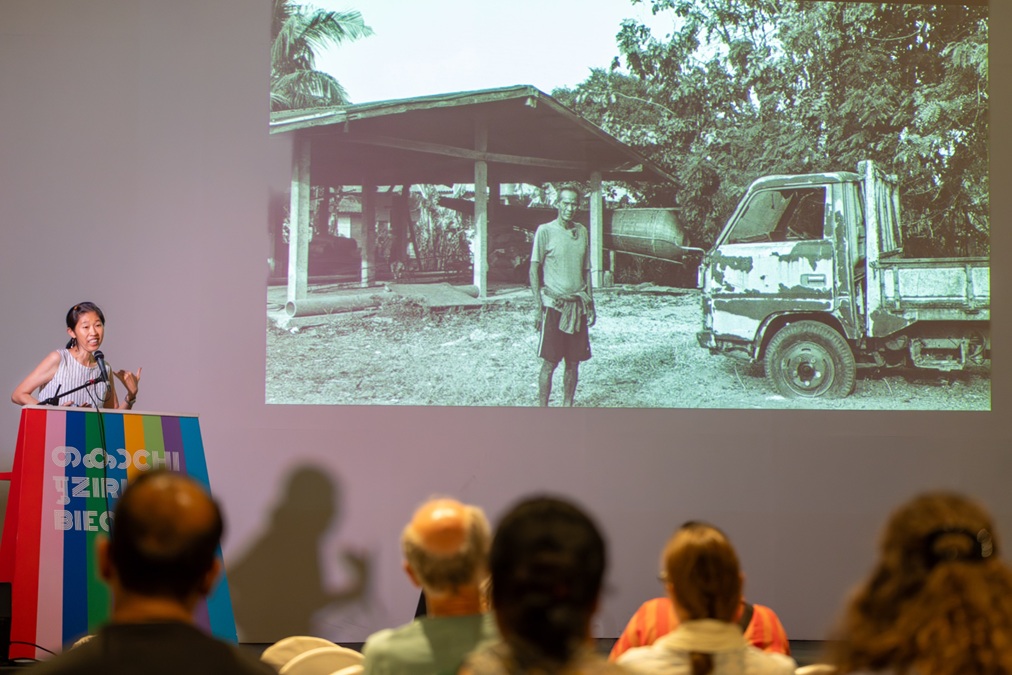
Thai visual artist and documentary filmmaker Som Supaparinya has brought a searing indictment of unchecked development to the ongoing Kochi-Muziris Biennale (KMB), where her work featured as part of the “Imagining Zomia” series.
Zomia is a term that refers to the vast highlands stretching from Central Asia to the southern reaches of Southeast Asia, including parts of India and China.
Long recognised in Southeast Asia for her politically engaged practice, Supaparinya’s contribution situates rivers not as neutral natural features, but as sites where power, capital and history collide, often with irreversible consequences.
The artist’s 2024 video installation, The Rivers They Don’t See, follows the trajectories of the Salween, Ping and Chao Phraya rivers, charting planned diversions, dam construction and the contradictions embedded in the so-called green energy policies. Rather than focusing only on visible destruction, Supaparinya dwells on absence: dried river courses, abandoned villages and ecosystems hollowed out by development projects framed as progress. The work resists spectacle, opting instead for accumulation, repetition and testimony.
Post-screening of the video, she dwelt on how large-scale infrastructure projects and extractive capitalism have reshaped both landscapes and lives, producing what she describes as “unseen” disasters. These include manmade earthquakes, destabilised riverbeds, forced displacement and the slow erosion of livelihoods dependent on water.
Crucially, the artist foregrounds voices that rarely enter official narratives. Refugees from Myanmar, migrant labourers and long-term riverbank residents speak of homes lost, waters poisoned and futures made precarious by decisions taken far from their communities. Their testimonies lend an intimate, human scale to policies often justified through technocratic language and national interest. In doing so, she exposes how rivers function as politicised environmental structures, deeply entangled with the colonial and postcolonial histories of Southeast Asia.
Supaparinya’s work resonates strongly with local contexts in Kerala, itself shaped by dams, floods and development-driven environmental crises. She extends this framework to examine how contemporary governance and capital now penetrate even the remotest ecologies. Rather than offering solutions, The Rivers They Don’t See asks viewers to sit with discomfort, uncertainty and responsibility.
The day also saw the screening of Abundance: Living with a Forest, a documentary that traces the everyday ecology of foraging, forest life and jhum cultivation in Nagaland. Following Zareno, a Lotha forager in the forests of Khumtsü, the film maps the journey to collect wild edible plants from forests. Quietly observational, it also talks about the looming loss faced by Indigenous communities under shifting government policies.
The film stresses the need to sustain indigenous knowledge, values and ecological practices in the face of disruption. This was followed by an online re-reading the history of plant foraging in the Himalayas within ecological and political contexts by artist-curator Yutong Lin.


more recommended stories

KOCHI:On entering the room, the viewer.

KOCHI:Melancholic and haunting, the music lingers.

KOCHI:The art presentation ‘Sweet Ascent –.

KOCHI:The 10th edition of Photo Brussels.

KOCHI:Long before the glacial lake burst.

KOCHI:The Kochi Biennale Foundation (KBF) will.

KOCHI: At the Arthshila venue of.

KOCHI: Riaz Hamidullah, High Commissioner of.

KOCHI: How about making celluloid as.

KOCHI: An illustration workshop, titled The Inner.
