





KOCHI:
At the Kochi-Muziris Biennale KMB), Ali Akbar PN’s Reliquary does something increasingly rare in contemporary art: it listens. Not for spectacle or provocation, but for what has been muted, marginalised, or deliberately erased.
Born in 1996 in Kerala’s Koolimuttam, and now based in Gujarat, Akbar belongs to ageneration shaped less by inherited certainties than by inherited fractures, of history, belief, and cultural memory.
His ongoing project Reliquary (2024–) is not an exhibition in the conventional sense, but a careful excavation of how heritage survives under pressure, how myths are re-scripted, and how architectural forms carry the weight of social conflict.
The works at the Biennale engage with heritage, mythology, and historical-cultural narratives, but they are firmly positioned within the urgency of the present. As Akbar puts it, “the works displayed at the Biennale are primarily concerned with heritage, the past, mythologies, architectural structures, and historical-cultural narratives, positioned within the urgency of the present social climate.” In a moment shaped by competing meta-narratives and the rise of counter-myths, he adds, these works respond to “the systematic destruction and erasure of heritage” and the deepening polarisation of contemporary social life.
A key conceptual gesture of Reliquary is its decision to place Gujarat in dialogue with Malabar, the historical and imaginative anchor of the Kochi-Muziris Biennale. “Within the context of the Biennale, which is deeply rooted in the layered histories, oceanic exchanges, and cultural memories of the Malabar Coast,” Akbar explains, “I felt compelled to narrate Gujarat as another coastal geography shaped by similar currents of trade, migration, belief systems, and cultural negotiations.”
By positioning the two regions side by side, the works reflect on how distinct coastal landscapes evolved through interconnected histories, even as their contemporary social climates diverge.
The material basis of the series lies in sustained site documentation, archival research, and imagination used as a methodological tool rather than an aesthetic escape. “The works have emerged from documentation of sites, the study of archival images, and an engagement with imagination to explore events, myths, rituals, vocabularies, and the lived difficulties of everyday life,” the artist notes.
Many of these sites now occupy a charged position within polarised narratives, even as the heritage associated with them remains neglected, marginalised, or actively threatened.
Several locations referenced in the works have already been damaged or erased; others exist under the looming possibility of loss.
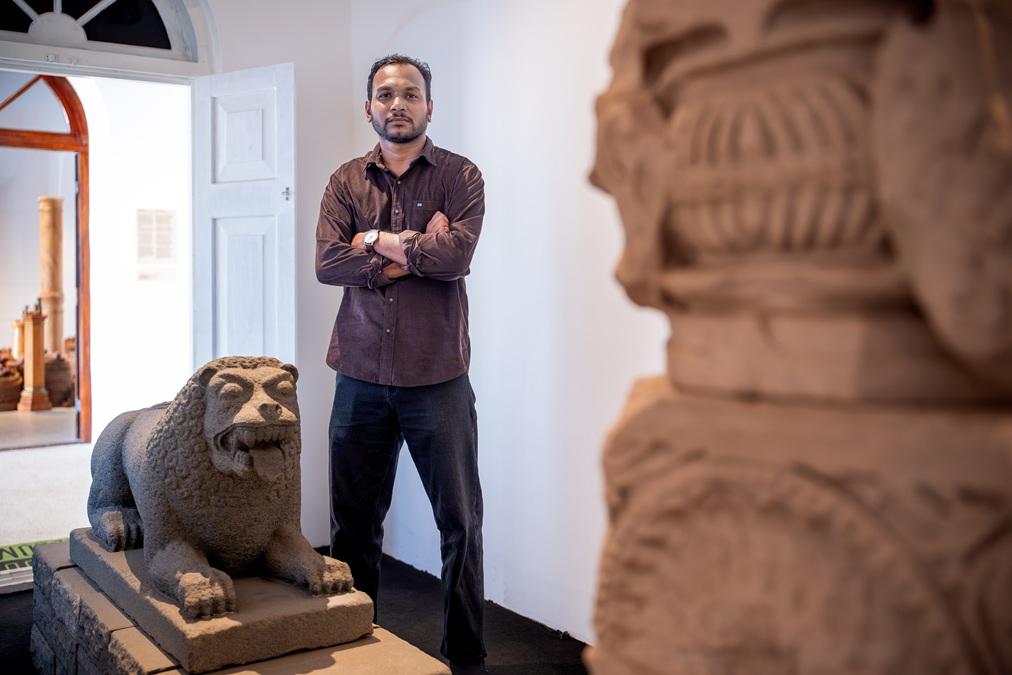
Among the most striking elements of the installation is a life-size carved stone pillar, produced collaboratively by Hindu and Muslim sculptors from Sirohi (Rajasthan) – artisans from a dwindling lineage of shared craftsmanship. The pillar functions as both anchor and rupture. Its ornamentation echoes temples and mosques across north-western India, while its fractured presence gestures toward a broken continuity. Architecture, in Akbar’s hands, becomes an archive of coexistence as well as conflict.
Nearby, a carved lion recalls a form historically shared across Indo-Islamic, Buddhist, and Middle Eastern traditions as a symbol of guardianship and strength. In Reliquary, however, that shared symbolism feels unsettled. What once suggested protection now reads as assertion, mirroring how cultural motifs are selectively reshaped to serve contemporary ideologies and narratives of dominance.
Running through the series is a sustained engagement with Gujarat’s plural spiritual legacy. “Gujarat carries a deeply rooted history of Sufi and universal spiritual traditions expressed in distinctly local forms,” Akbar observes, referencing figures such as Imambawa Shah and Jhulelal alongside Kabir Das and Bulleh Shah.
Historically, Sufi shrines functioned as collective spaces where people across castes, religions, and belief systems gathered in shared ritual, a lived pluralism that contrasts sharply with present-day manipulations of cultural memory.
In this sense, Reliquary is conceived as both remembrance and resistance. “It is an attempt to mark, archive, and re-imagine forgotten, sidelined, and endangered heritages before they are irrevocably lost or erased,” Akbar says.
By bringing these fragments into the present, the work asks difficult questions about whose histories are preserved, whose are silenced, and how cultural memory might be reclaimed amid ongoing destruction and polarisation.


more recommended stories

KOCHI:An array of celebrities from different.

KOCHI:Few might have considered that kitchen.

KOCHI:Algerian artist Kader Attia has opined.

KOCHI:Paul Thoppil, Canada’s High Commissioner to.

KOCHI:It’s all in the gaze in.

KOCHI:While much of the city lingered.

KOCHI:At the newest edition of the.

KOCHI:Meenu James’ paintings transcend the confines.

KOCHI:At the Kochi-Muziris Biennale (KMB), artist.

KOCHI:The KMB Pavilion, described as the.
