





KOCHI:
Moulds without a name are discarded as waste, then what of the labourers whose name was never inscribed? These are words inscribed on the main installation by artist Birender Yadav at the Kochi-Muziris Biennale 2025.
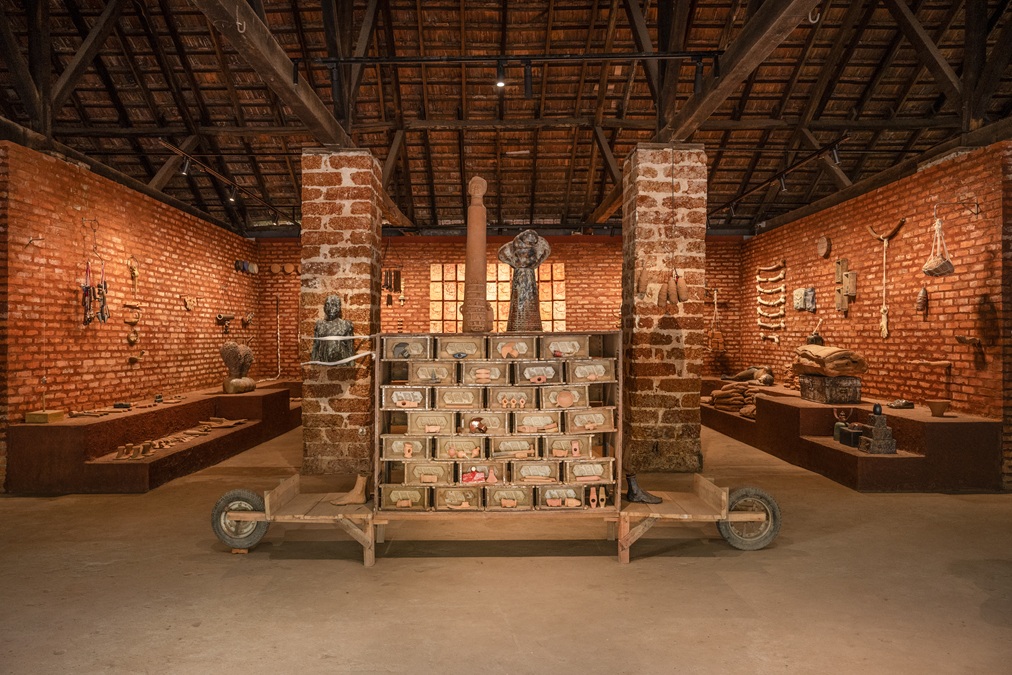
The work, ‘Only the Earth Knows Their Labour’, is on at the art-show’s vital Aspinwall House venue, serving as a fitting epitaph to the nameless and faceless worker who is never acknowledged or recognised. These profound words, on display at the Coir Godown, encapsulate the bitter reality that the worker is not even a face in the crowd.
In fact, there are no workers in young Yadav’s installations. And yet, their presence is everywhere. Step into ‘Only the Earth Knows Their Labour’, and the air feels dense, reddened by clay, heavy with an effort that has no visible body. Brick walls rise and curve; steps form a slow, enclosing geography; and at the centre stands a terracotta structure redolent of the flue of a brick kiln. What is missing is as important as what remains. The labourers are absent, but their presence is felt in every exhibit in the installation, from the tools to the bent and broken spinal cord; their labour refuses to disappear.
Yadav’s work at the 110-day biennale is rooted in the lives of seasonal migrant workers employed in the brick kilns of Mirzapur in south-eastern Uttar Pradesh. Many of them are landless, bonded and trapped in cycles of debt and extraction that pass quietly from one generation to the next. The artist has spent years observing not only how these workers live and work, but how their identities are shaped, and erased, by the systems they serve.
“While doing BFA in Banaras Hindu University, I got an opportunity to visit Mirzapur and interact with the migrant labourers in the brick kilns and see the process in depth,” recalls 34-year-old Yadav. “The memories of the toil and sweat of the workers, inhumane treatment, their exploitation and suffering took root in my installation here.”
Now based in Delhi, Birender finds Kochi relaxing. “This city is fresh, friendly and less polluted,” he says. Born in UP’s Balia and having had to migrate to Jharkhand after his father got job in the coal mines of Dhanbad, this is not Birender’s first visit to Kerala. “I have visited Kochi for earlier editions of the biennale with my friends from college. But I never dreamt of exhibiting here.”
In this installation, the kiln is reconstructed without spectacle or sentimentality. Instead, it becomes an architecture of endurance. Each brick bears palm impressions pressed into wet earth, traces of bodies that once shaped them. These marks are not decorative; they are residual gestures of survival. They recall hands that have pressed, lifted, stacked, and burned clay day after day, often without contracts, safety, or recognition. “They are reflections of my observation in the kilns which I have documented,” he says.
Scattered across the installation are terracotta casts of everyday belonging, like tools and items of clothing, left behind in the workers’ temporary dwellings. Recast in clay, these objects become quiet biographical fragments. Each carries subtle variations: a dent here, a fold there, an asymmetry shaped by its former owner’s hand. In a sea of uniformly sized bricks, these differences matter. They assert individuality where systems insist on sameness. These objects function as surrogate bodies. They stand in for workers who are otherwise
rendered invisible, insisting, softly but firmly, on presence. The installation suggests that identity survives not through grand narratives but through use, wear, and touch.
At the heart of Yadav’s practice is the relationship between the worker’s body, their labour, and the material they handle, the earth itself. In Only the Earth Knows Their Labour, these elements are inseparable. The earth remembers the body that shaped it; the body carries the fatigue of the earth it has worked. Clay becomes both medium and witness.
This entanglement continues in Yadav’s accompanying drawings, made using soil and dust collected directly from kiln sites. The gestures of pressing, crushing, and casting are abstracted onto paper, translating physical exertion into visual rhythm. These works do not illustrate labour; they echo it.
The installation envelops the viewer in a monochrome world of red and ochre, concentrating centuries of labour knowledge into a single sensory field. There is no narration, no didactic explanation. Instead, the space demands slow attention. You walk among bricks that feel identical until you notice the palm prints. You notice the objects only after realising they are not props, but lives condensed into form.
Yadav does not offer resolution. There is no redemption arc here, no heroic framing. What he offers instead is insistence: on memory, on material, on the dignity of labour that history often overlooks. The title feels less poetic than factual. When systems forget, when economies move on, only the earth retains the imprint of those who worked it. In this silent kiln, labour speaks, not through voices, but through clay.
The sixth edition of the biennale, with ‘for the time being’ as its curatorial title by Nikhil Chopra and HH Art Spaces, Goa, runs till March 31, 2026.


more recommended stories

KOCHI:Seeking to kindle the interest of.

KOCHI:As the 6th edition of Kochi-Muziris.

KOCHI:Those above the age of 75.
KOCHI:The Kochi-Muziris Biennale (KMB) today formally.
KOCHI:The Art Room “is a space.

KOCHI:Ernakulam District Collector Priyanka G visited.

KOCHI:The Kochi Biennale Foundation (KBF) has.

KOCHI:Acclaimed Ghanaian artist Ibrahim Mahama, whose.

KOCHI:The Kochi Biennale Foundation announces 11.

KOCHI:The Kochi Biennale Foundation (KBF) has.
