





THIRUVANANTHAPURAM:
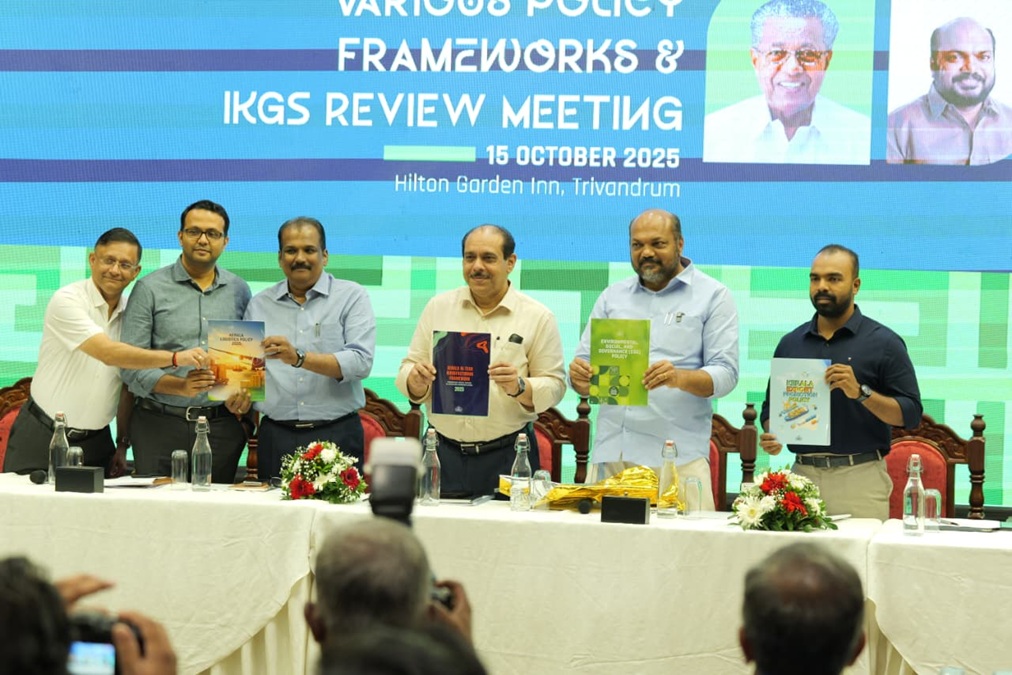
Kerala Government has launched its Export Promotion, Logistics and ESG policies, besides the High-Tech Framework, giving an added thrust to the New Industrial Policy (NIP) which pivoted a profound transformation of the state’s industrial landscape.
Unveiling the policies at a press conference here today, Minister for Industries, Law and Coir P Rajeeve said these strategic initiatives are aimed at firming up the state’s standing as highly promising investment destination for sustainable and responsible projects in key verticals including high-tech driven service sector, manufacturing and export-oriented high-value enterprises.
Principal Secretary, Industries, APM Mohamed Hanish; Kerala State Industrial Development Corporation (KSIDC) Managing Director Vishnuraj P; KSIDC Executive Director Harikrishnan R; KINFRA MD Santhosh Koshy Thomas; K-BIP CEO Suraj S attended the press meet.
The newly launched policies, aligning well with the NIP framework, will build on the momentum imparted by the Invest Kerala Global Summit (IKGS), held earlier this year.
Aligning well with its fast-paced transition into a knowledge economy, Kerala has become the first Indian state to adopt a comprehensive Environment, Social and Governance (ESG) policy, which provides for a slew of incentives and supports to investors.
The Kerala ESG Policy 2025 embeds sustainability, ethics, and social equity into the DNA of Kerala’s industrial and investment ecosystem. It aims to promote environmentally feasible and inclusive industries, which also follow transparent and responsible governance practices, Rajeeve said.
The policy comes with a set of incentives and supports such as tax concessions, subsidies, easy credit support for the investors. There will be startup incubation and R &D support to back up the flourishing innovation ecosystem.
A State ESG Monitoring Cell under the Department of Industries & Commerce will coordinate ESG adoption at the enterprise level. The policy aims to achieve carbon neutral status for the state by 2050 and transition into renewable energy by 2040.The capital on ESG components of will be entitled to 100 per cent reimbursement for five years.
There will be increased investment in solar parks, floating solar systems, wind mills, hydro power stations and biomass projects.
The Export Promotion Policy 2025 aims to increase exports and integrate industries with global value chains, besides repositioning Kerala as a globally competitive export hub, with a target of reaching USD20 billion in exports by 2027-28, Rajeeve said.
Diversification of the export basket, modernization of export infrastructure, skill development, market intelligence, and brand building under the “Made in Kerala” brand are some its key features.
It seeks to ramp up the high-value and sunrise sectors including biotechnology, life sciences, aerospace and defence manufacturing, electronics, Ayurveda and pharmaceuticals, processed food, and services exports like IT, tourism, and healthcare in the ecosystem.
Right now, Kerala’s export basket largely comprises marine products, spices and engineering and petroleum products. The new export promotion policy seeks to expand the scope to high-value segments like biotechnology, life sciences, aerospace, defence, electronics, Ayurveda, pharmaceuticals, IT, tourism and healthcare, the Minister said.
It also seeks to revitalise traditional sectors like coir, cashew, handloom, and plantation products through technology infusion, design innovation, and market diversification.
There will be multi-tier facilitation structure such as a state and district export promotion committees and a state facilitation desk.
Kerala Logistics Policy 2025 provides for a comprehensive roadmap to make the state a high-efficiency, multimodal logistics hub to support manufacturing, exports, and domestic commerce.
It aims to reduce logistics costs to below 10% of GSDP through a coordinated, technology-enabled approach. It envisions to establish Kerala as a cost-efficient, sustainable, and digitally connected logistics hub that serves as a gateway for exports and regional trade.
Strengthening multimodal transport connectivity between industrial clusters, ports, and airports; encouraging private investment in warehousing, logistics parks, promoting green and digital logistics ecosystems, building a skilled logistics workforce to support modern supply-chain operations; a regulatory framework to ensure coordination among the ports, transport, and Industries Department are among its the key features.
A core component of the policy is the creation of a network of logistics parks and nodes to cater to industrial and trade sectors.
Integrated Logistics Parks (ILPs) will have large-scale, multimodal facilities combining warehousing, cold storage, distribution, and value-added services. Each ILP will serve as a regional logistics hub integrating road, rail, seaport, and air cargo movement.
The policy is expected to attract significant private investment in warehousing and freight management and generate over 50,000 direct and indirect jobs.
Meanwhile, Kerala Hi-Tech Framework 2025 will serve as the strategic blueprint for developing the State’s advanced manufacturing and innovation ecosystem, the Minister said.
It seeks to position the state as an innovation-driven manufacturing hub, capable of attracting global investors, increasing exports and generating high-skilled employment. It reflects on the government’s vision of moving from resource-based to knowledge-based industrialization, driven by technology, R&D and intellectual property.
The framework identifies sectors with high global growth potential like semiconductors, electronics system design and manufacturing (ESDM), biotechnology and life sciences, aerospace and defence, medical devices, robotics, nanotechnology, and advanced materials. It emphasizes self-reliance through design, innovation and high-value manufacturing.
It seeks creation of Hi-Tech Manufacturing Parks and Innovation Clusters across Kerala’s industrial belts, particularly along the Kochi–Palakkad–Thiruvananthapuram Corridor. These will feature plug-and-play facilities, shared R&D and testing infrastructure, incubation centres and collaboration spaces for academia and startups.


more recommended stories

THIRUVANANTHAPURAM:Kerala Industrial Infrastructure Development Corporation (KINFRA).
THIRUVANANTHAPURAM:The State Budget for 2026-27, presented.
KOCHI:The Kerala Startup Mission (KSUM) has.

KOCHI:Cochin International Airport Limited, in collaboration.

KOLLAM:With multiple infrastructure projects underway, improved.

KOCHI:Scaling up its overseas market, Kerala.

THIRUVANANTHAPURAM:The hugely successful Adopt-a-Village programme spearheaded.

THIRUVANANTHAPURAM:Leading Robotics Process Automation (RPA) and.

KOCHI:“Kerala has evolved as an ideal.

MUMBAI:Bharat Petroleum Corporation Limited (BPCL), a.
