





KOLKATA:
Certain countries have set “unreasonably high” standards for import of commodities as part of precautionary norms, causing concern for marine exporters from developing nations and raising the cost of production manifold, according to a top government official.
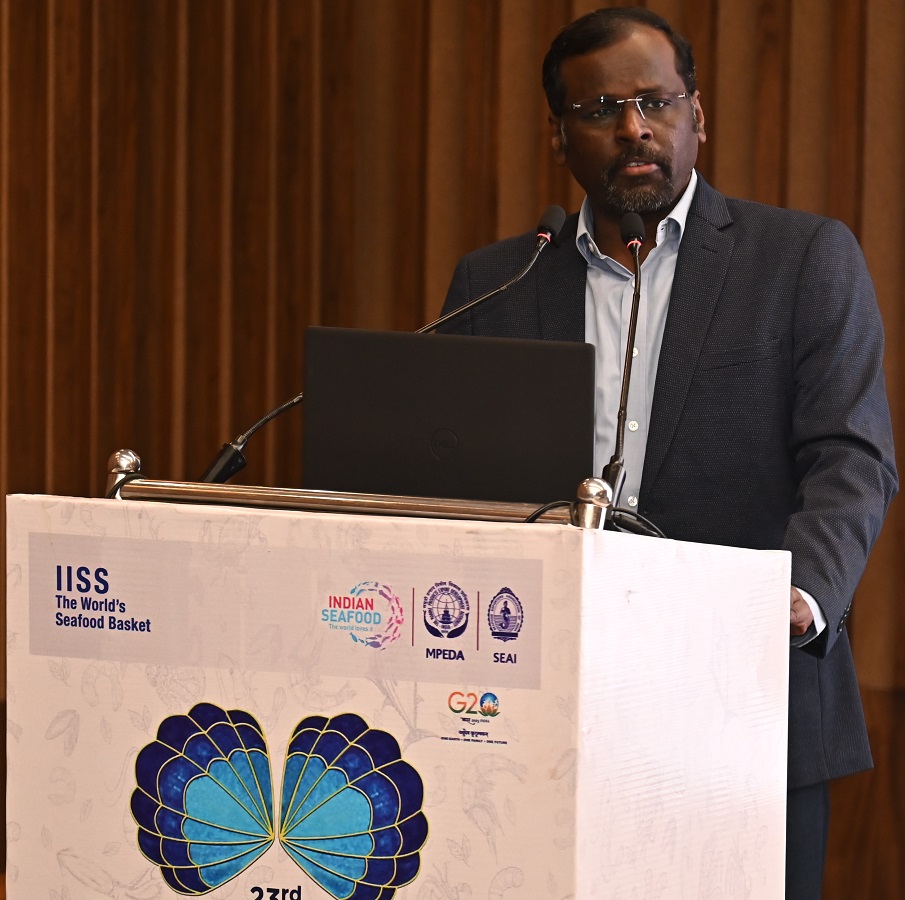
More and more countries are coming out with restrictive measures that are not in tune with the framework of World Trade Organisation (WTO), Dr M Balaji, Joint Secretary, Department of Commerce, Ministry of Commerce and Industry, GoI, told the India International Seafood Show (IISS) in the city.
Speaking at a session on ‘Seafood Trade Regulatory Measures in Selected G20 Nations’ at the 23rd edition of the February 15-17 event, he explained that the Sanitary and Phytosanitary (SPS) agreement primarily relies on two fundamental cornerstone principles. “One, it has to be based on a scientific principle. Two, it has to have a reasonable evidence-based justification,” he pointed out. “But more and more countries are trying to move away from transparency in the past 10 to 15 years.”
Around 45,000 STCs (Specific Trade Concerns) have been placed on the SPS side alone since 1995, the speaker substantiated. “This is one of the serious concerns for a developing country like India.” He also mentioned that equivalence and mutual recognition are the ways to resolve the problems, which are being erected under the SPS pillars.
Highlighting that the EU’s precautionary residue level of 0.01 ppm in the exporting commodity is absolutely unmeasurable and unviable for exporters and manufacturers, the official said manufacturers produce an entire batch for a particular country and in case of rejection then their entire batch processing goes in vain as they can’t revert it to domestic market. “EU has come out with online-based documentation through which every certificate or testing can be updated so that there is no movement of physical certificates and individuals between countries. This would bring down the cost to a larger extent,” he added.
Dr Balaji urged stakeholders to work on innovation, branding and collaboration, which are the standard established principles across the globe. “We must compete and make our product completely integral to importing country and make it indispensable. It is the only way that we can burgeon our export chain in the future,” he said.


more recommended stories

THIRUVANANTHAPURAM:Kerala Industrial Infrastructure Development Corporation (KINFRA).
THIRUVANANTHAPURAM:The State Budget for 2026-27, presented.
KOCHI:The Kerala Startup Mission (KSUM) has.

KOCHI:Cochin International Airport Limited, in collaboration.

KOLLAM:With multiple infrastructure projects underway, improved.

KOCHI:Scaling up its overseas market, Kerala.

THIRUVANANTHAPURAM:The hugely successful Adopt-a-Village programme spearheaded.

THIRUVANANTHAPURAM:Leading Robotics Process Automation (RPA) and.

KOCHI:“Kerala has evolved as an ideal.

MUMBAI:Bharat Petroleum Corporation Limited (BPCL), a.
